The Pinewood Players Present
Holy City
by
Copyright © 1996 by Roger Altenberg
- Robert Snyder — Director of the Pinewood Players
- Joy — actress (playing Waitress)
- Fenton Dillquist — actor (playing Rabbi)
- John — Stage Crew Manager
- Bill Jordan — President of the Pinewood Players and actor (playing James)
- Mrs. Gillespie — Costume manager and actress (playing Mary)
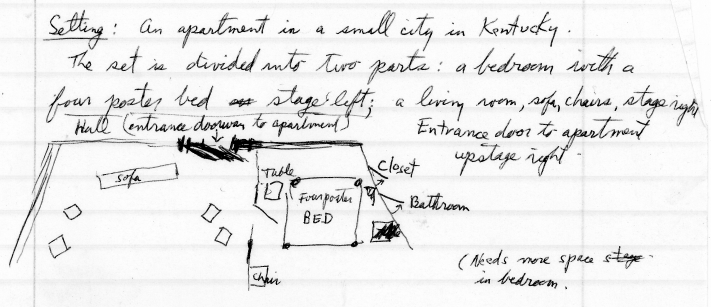
[In bedroom. Robert is taking a nap on the bed. His shirt is on a chair in the living room. He is lying bare chested on the bed. The alarm clock on the table rings. He reaches out a sleepy arm to turn it off. He Sits up in bed. He holds the clock and looks at it.]
ROBERT: Six forty-five P.M. They'll be here any minute for rehearsal. I'm hungry.
[Reaches into table drawer, pulls out package of cookies]
Fig Newtons. [Eats fig newton]
I'm so tired. I could sleep another ten hours. My God–what a dream that was. Why am I so horny? It's only been a year.
[Knock on apartment door] Damn.
[Looks at watch] They're not supposed to be here for another twelve minutes.
[Puts on bathrobe, crosses to living room, opens apartment door.]
[Joy, 27 years old, is standing in the hallway]
ROBERT: Hi, Joy. You're a little early.
JOY: I know. But I had to talk to you about my costume.
ROBERT: Mrs. Gillespie is in charge of that.
JOY: Yes, but this is personal.
ROBERT: [Cordially] Well come in. [Joy enters living room] I just woke up from a nap.
JOY: You look tired.
ROBERT: How can I get any sleep when we open Holy City in two days. They're just starting to build the set in the auditorium.
JOY: So that's why we're still rehearsing here–in this apartment?
ROBERT: Yeah. It doesn't look much like ancient Jerusalem.
JOY: [Staring in direction of bedroom] It looks nice to me..
ROBERT: So how's your husband handling your being away for so many rehearsals?
JOY: He's gone off to another of his motorcycle rallies. Some kind of Grand Prix.
ROBERT: To each his own.
JOY: He should have gotten a license to marry his Harley.
ROBERT: [Nodding] A same-sex wedding.
JOY: I'm so fed up with his act. He's always snarling. Listen, do we have a minute to talk
seriously?
ROBERT: [Takes off bathrobe, picks up shirt from chair and puts it on] Is this about your costume?
JOY: Well, Robert–you don't mind if I call you Bob?–I know I'm just playing a waitress in a tavern in Jerusalem when Jesus brother James walks in–
ROBERT: Uh-huh.
JOY: But this blouse Mrs. G has given me is all wrong. See I've got it on. Notice how high the neckline is.
ROBERT: Ye–es.
JOY: I want to open it up down to here.
ROBERT: [Robert's eyes bulge slightly] That far down.
JOY: Sure. Give Jerusalem a little life.
ROBERT: This is a religious play.
JOY: So was "The Ten Commandments". Hollywood knows how to put a little sex in with the Bible.
ROBERT: Joy this is my first paid theatre directing job. I was broke in Los Angeles, and I was even worse off in New York. For two years I've tried everything to get even a toenail in the door–stage, TV, films. That's why I came here. It's work. I've got to make this a success.
JOY: I know I can help you to make it an exciting play.
ROBERT: Since I arrived here four months ago, I've bent myself in every direction to get along with the Pinewood Players and the people in this town.
JOY: I know–
ROBERT: They offered me shots of 100 proof Bourbon. I drank with them. They wanted the church crowd to see their next play. I hunted around and found this script. I'm doing all I can, but sometimes I feel so alone.
JOY: That's why you need my help.
ROBERT: I really appreciate all the props you collected. And the loan of your cassette player for rehearsals.
JOY: Bob–I'm going to call you "Bobby". You're a real inspiration to a person like me. I've been married to Joe for ten years, since I was 17. He doesn't want me to hold down a regular job. Too many guys out there looking me over. He doesn't want me to be anything but his property.
ROBERT: That's–uh–hard.
JOY: What I see in you is your dedication to your art. I could be a Hollywood starlet. I've got the measurements.
ROBERT: Oh, yes.
JOY: I need someone who believes in me.
ROBERT: Absolutely.
JOY: You probably know a lot of Hollywood producers.
ROBERT: I know their receptionists.
JOY: That's what I mean..
ROBERT: Joy, right now I'm just wanting to keep everybody happy and keep my nose clean. So please, just keep your shirt on.
JOY: [Smiling] I didn't plan to strip..
ROBERT: [Comes over to her, touches her shoulders] You've been a real friend. [Looks into her eyes]
[Knock on entrance door. The knob turns and Fenton Dillquist enters. He is a small wiry man with a high strung manner.]
FENTON: Oh, you're rehearsing already.
ROBERT: [Doing a quick adjustment to the "intruder"] [As director to Joy, the actress:] So Joy, you hold in this position near the table. Got it?
JOY: Got it.
FENTON: I don't want to interrupt you, but I am boiling over.
ROBERT: [Crossing to him] What's the matter, Fenton?
FENTON: Here's the evening paper. See the drama news. Pinewood Community Players opening Holy City.
ROBERT: [Looking at article Fenton is displaying in the newspaper] Yes–that's the publicity item the theatre sent the entertainment editor.
FENTON: Don't you notice anything wrong?
ROBERT: It's just the basic info, and the cast list.
FENTON: Well? [Head of steam rising]
ROBERT: It seems to be in order.
FENTON: Seems? They have omitted my name. Every last spear carrier is mentioned, but me The Chief Rabbi of Jerusalem–no. There is no Fenton Dillquist here. I have played featured roles for years. Someone in this theatre is out to get me. I can think of several who might–but I didn't think they'd actually stoop so low. Who wrote the publicity material?
ROBERT: I think the President of the Players did–Bill.
FENTON: Bill Jordan?
ROBERT: Or he delegated it to the woman who volunteered to work on publicity.
FENTON: That bitch. Oh, excuse me Joy. It's just too much.
JOY: It's got to be just a little error.
FENTON: Ho-ho-ho. I know better. Now Robert I'm asking you to find out immediately who did this ugly thing.
ROBERT: I can't stop my next-to-last rehearsal to do that.
FENTON: In that case, I quit. Ask that snivelling cutesy publicity girly to play the Chief Rabbi!
JOY: Which scenes are we going to do?
ROBERT: We'll do your tavern scene with Jesus' brother James; and since Fenton is here, perhaps he'd be kind enough to do the scene where James seeks help from the Rabbi.
FENTON: I'm still quitting. I'll be in the garden composing a letter to the Entertainment Editor. He's often made carping little comments about my acting. Maybe he's the one responsible.
[As Fenton heads out the entrance door, John
Willis comes in wearing scene-construction clothes. He's covered with saw dust. He is the stage manager, technical director.]
JOHN: Robert, we gotta problem. Hi Joy.
JOY: Hi, John. Workin' hard?
JOHN: Hard, but crazy!
ROBERT: What's happening at the auditorium? Have you got a crew?
JOHN: Yeah. There's a few of us. And Bill Jordan has brought some employees from his construction company.
ROBERT: That's great.
JOHN: Not so great. You know as Technical Director I'm supposed to approve the set design and construction. Well, Bill, being an engineer, thinks he knows better.
ROBERT: What's he done?
JOHN: For the basic Jerusalem set in Act I, including the tavern, he has brought in leftover lumber from one of his construction sites.
ROBERT: That's good.
JOHN: You haven't seen the lumber. Look at this piece. [Holding post out] He's building the set out of heavy, heavy, four-by-six posts, plywood walls, all nailed together. Real glass windows, a fountain made of real bricks, cemented together. He won't accept that we have to change the scenery for Act II.
ROBERT: Why the heavy stuff?
JOHN: He says "This set has to be solid. Lot of action goin' on there. I've got all this lumber available for free. We can't go out and buy other materials–we've gotta pay royalties and Robert's salary. We'll find a way to bring in the other sets. This one is going to stay put!"
[A second figure emerges at the doorway. It is Bill Jordan]
BILL: You're damn right about that, John.
JOY: I think I'd better join Fenton in the back yard. [Goes out door]
BILL: [Seeing Joy; with a wink:] How's our lovely waitress?
JOHN: Bill, I've been explaining the situation to our director.
BILL: I heard. Figured I'd better get right over here.
ROBERT: We have to finish the sets tonight. We must be ready for our one and only dress rehearsal tomorrow.
JOHN: I can't keep my crew working until morning. They're due at their offices by 8:30 AM. Sam Carmichael has to do surgery at seven.
BILL: My construction guys are real workers.
They'll stick by me as long as I tell 'em.
JOHN: Tell me this: Once you've nailed down your Jerusalem apartment house just where are we going to place the Act II sets?
BILL: In front.
JOHN: We've got about three feet, then
you fall into the orchestra pit.
ROBERT:
We have to use the space we've planned for Act II.
BILL: Not to worry. We'll build a platform out over the
orchestra pit and the first two rows of seats, if we have to.
ROBERT: You've got the lumber for that?
BILL: I have truckloads of extra lumber
standing by at Rosy Springs Villas–we just finished that whole
development.
ROBERT: [To John] Can we light all that
extra stage area in front?
JOHN: Our lighting man hasn't shown
up. His wife said he's at his
Wednesday Rotarian dinner. But
he'll be there tomorrow.
ROBERT:
That's real nice of him. And if
not then, maybe sometime after we open on Friday. Bill, how can you manage to build a whole new stage and
construct these sets in one night?
BILL: No sweat. You should see how fast we build our
houses. We won the last regional high-speed construction contest. We were faster than nine other
development companies.
ROBERT: I'm beginning to understand how
your recent director, Nigel Elliot, had a nervous breakdown in the middle of
the season.
BILL: He was a burned out old
Englishman. You're young, Robert.
ROBERT: I'm aging rapidly.
JOHN: I'm very uneasy about the
construction plans.
BILL: You worry too much. We're on top of this.
ROBERT:
Are you on top of things enough to stay and rehearse your scene with the Chief
Rabbi?
BILL: I almost forgot I'm acting in
this show.
ROBERT:
You are Jesus' brother James–that's not chicken liver.
BILL: True.
ROBERT:
And Fenton Dillquist is outside foaming at the mouth.
BILL: I should get back to the set.
JOHN:
I'll oversee while you're rehearsing.
I am the technical director.
BILL: Tell my men I'll be back there soon.
[John exits, taking the piece of lumber and
brick with him]
BILL: What's with Dillquist?
ROBERT:
He's in a snit because his name was omitted in the publicity piece.
BILL: Is that all?
ROBERT:
He's threatened to quit the show. [Looking out door] And I
think I hear him coming up the stairs.
BILL: [Fenton appears] Well,
hi there buddy. How's old Fenton
today?
FENTON: There you are, Mr. William
Jordan–our dear President. I want an explanation immediately.
BILL: I heard ...
FENTON: You heard–that someone–you,
or that little witch of the North–or maybe your dear editor friend at the
newspaper–is trying to cut off my balls.
BILL: No one would do that.
FENTON: They have tried.
BILL: At this point that's impossible.
ROBERT: [To Fenton ] Show
them all that you have created a towering figure as the head Rabbi.
FENTON: Chief Rabbi.
ROBERT: Bill's here to rehearse that
moment when the disciple James comes to you. Except for the high priests, you are the most powerful Rabbi
in the city. It can be a hell of a
scene.
FENTON: I meant it when I said I was
quitting.
ROBERT: But you'll rehearse it now
anyway–?
BILL: To help me out?
FENTON: To help our director. I don't know about you.
ROBERT: O.K. Here's the chair of the head Rab– the Chief Rabbi.
And you sit at stage right, remember.
FENTON: I certainly should. We did it yesterday.
ROBERT: All right–Begin.
FENTON: I want to put on my Rabbi's robe. I have it in this bag.
[He takes out the Rabbi's robe and puts it
over his street clothes. Fenton sits
majestically on the chair, arranging his robe and brushing back his hair.]
FENTON: And my crucifix. [Putting it around his neck; it's on
a cord.]
ROBERT: What?
FENTON: I thought it would be a nice
touch..
ROBERT: [Robert and Bill exchange
glances. Robert gestures as if to
say, "Anything now to get the scene going"]
RABBI: I do not like the sounds I hear in the
streets. The crowds of worshippers
are becoming unruly. The
soothsayers have predicted trouble lies ahead. I wish I were out of here–bathing in the Red Sea. But one cannot shirk his duty. Someone approaches– [Stands
up–claps his hands] You guards, see who is there. Oh, if I could but shake off this
premonition of disaster that sticks like a foul leech to my skin. Who is it?
JAMES: It is a humble friend, great Rabbi.
RABBI: The guards let you in? What is your name?
JAMES: I am James, brother and disciple of the
Nazarene.
RABBI: Are you not also a trouble maker, a
thorn in the side of the Pharisees, and the Sadducees?
JAMES: No, Rabbi. I have come peacefully with the others from Nazareth to
Lashish, to Beth Tolach, by way of Kefar Hashmon, and the Valley of
Kish-ba-sholem-Hephzat.
RABBI: I have heard rumors of uprisings in
that region.
JAMES: No, Rabbi. All was peaceful along the rivulets of Bar Mizrahi into the
pine-blessed hills of Noz–, Noz–
ROBERT: [Interrupting Bill] Noz drahum.
JAMES: Noz drahum and ...
ROBERT: Shittim.
BILL: Shittim? [Aside, to Robert] Do you
really want me to say that?
ROBERT: It's an ancient town..
BILL: Couldn't we translate some of these
names.
ROBERT: How?
BILL: Guess you're right.
FENTON: May we please get on with the scene.
[Bill nods acquiescence.]
RABBI: What do you want of me?
JAMES: I seek protection for our company of
worshippers.
RABBI: Protection. [Tugs on his robe, James
is standing on the edge of it] Protection [Tugs harder] I am a
religious teacher, not a policeman.
[Out of side of his mouth–to Bill] Will
you stop standing on my robe.
JAMES: But you have influence on the High
Priest and the Sanhedrin.
RABBI: [Majestically sweeps past James] In
myself I am nobody. But when the
light of faith shines through me, the holders of power do listen to my
words.
JAMES: [Kneeling at his feet] You
must help us. [Grabs the Rabbi's robe]
RABBI: Ow. [Aside] You
pinched me. [Aloud] Take
your hands off my person.
JAMES: Please. [Rabbi slaps his hand.]
RABBI: Enough.
JAMES: We are here to purify.
RABBI: I'll purify you– [Takes off
Crucifix–and starts hitting James]
ROBERT: Fenton! Fenton. Get hold of yourself.
BILL: What's happened to you?
FENTON: It's all too much. [Sobbing] There's no respect for
me. You're trying to make a fool
of me.
BILL: No, you're great.
ROBERT: You were doing fine.
FENTON: I need a glass of water.
ROBERT: There's a glass in the bathroom. [Pointing to bedroom]
[Robert and Bill look at each other,
perplexed as to their next move. Mrs. Gillespie, a woman in
her fifties, knocks on the apartment door. Robert goes over to let her in.]
MRS. GILLESPIE: Robert, I came as fast as I could to do
my scene. It's not easy being the
costumer and playing a role.
ROBERT:
You could let your assistant take over now.
MRS. G: I know, but she just doesn't have
enough experience.
ROBERT:
We're going to do the tavern scene next.
MRS. G: Good. So I'm right on time.
I saw Joy out in the yard going over her lines. You know she must have taken that
blouse from the auditorium. I told
her not to. I was still working on
it. It's too low-cut.
ROBERT: I'll go get her. [Exit
through apartment door]
BILL: Hangin' in there, Mrs. G?
MRS. G: William, I declare this show is
becoming a three ring circus. [Sound
of Fenton sobbing] What's that sound?
BILL: Fenton is a little upset.
MRS. G: [In a hushed voice] When isn't he?
What's the matter?
BILL: He takes being a Rabbi very
seriously.
MRS. G: Well, he should. My whole church says they're coming to
see this play. Now if we can just
get Joy to forget Hollywood and remember that she's in Jerusalem we'll all be
better off.
[Robert, offstage, opens the door–Joy
enters, followed by Robert]
JOY: Hello, Mrs. G.
MRS. G: Hello, deah. I notice you are wearing that blouse.
JOY: [Cheerily]
Yes. I needed it to get in
character.
MRS. G: We need to do some more work on
it.
JOY: Well let's just do our rehearsal
now.
ROBERT: Yes, the tavern scene. [Setting the stage] Here's
the table, and the chairs. As the scene begins, Joy is wiping off the
table. Bill, you're off Left, ready
to make your entrance. You can use
the bedroom door the way we've always done. And Mrs. G, since you have only a few minutes before your
entrance as Mary–wait there
in the bedroom too. O.K. Joy: places–lights up. Begin.
[Joy, as Waitress, wipes the table with a
damp cloth. She swivels her hips a
bit.
Fenton emerges from bathroom and with great dignity crosses
past Mrs. G and Bill into living room.
Robert indicates for Fenton to sit on chair downstage, R. in living
room, near director's chair. Fenton
looks at Joy with a bit of disapproval.]
WAITRESS: [Picking up tip] A coin
from Rome. Not bad. I'll get a lot of shekels for it. [Puts it in her pocket.
Goes to imaginary window stage Left] The crowds keep coming by–but not
many have entered this place. I'll
take these dishes to the kitchen and get wine ready. [She sashays out to stage Right]
[Bill, as James, enters "tavern"
from bedroom door]
JAMES: A moment's refuge. I am glad I told Mother to meet me
here. No one will recognize us. This Holy City is dangerous ground for
all of us. Bug where can the owner
be?
WAITRESS: [Coming back out to give
table another wipe] Oh, sir–I didn't hear you come
in.
JAMES: Are you the owner of this
tavern?
WAITRESS: No sir, I work here. [Fiddling with blouse]
JAMES: Do any of the high priests or
the Roman officials come here?
WAITRESS: I've never seen them. Just working people eat and drink wine
here.
JAMES: That's good. I'm expecting–a friend. Bring me some white Samarian wine.
WAITRESS: Yes, sir. In a moment. [Sashays again to kitchen]
JAMES: The danger is mounting. Mother Mary is not safe walking. Perhaps Judas is accompanying her. He is very obliging.
[Mrs. G enters as Mary]
MARY: [Relieved]
James–this is the right place. I wasn't sure.
WAITRESS: So your friend has arrived. Here's the wine.
JAMES: Yes. [To Mary.
Pertly] Would you like a glass? It's the best wine from the hill country.
MARY: No, thank you kindly deah.
ROBERT: [Prompting] Just
"no thank you", Mrs. G.
MARY: No thank you, deah.
[Waitress goes and gets water from table off
Right]
MARY: [To James] Have
you seen the others? We must get
to the outskirts of the city.
JAMES: Shush, Mother. This woman may hear you.
MARY: Could she be an informer?
JAMES: I don't think so. Shush.
WAITRESS: I brought you some water. [She bends over, pulling blouse down
a bit]
MARY: [Dumbfounded]
Yes–you have.
ROBERT: [Prompting] You
just say "Thank you", Mrs. G.
WAITRESS: I thought you might be thirsty.
MRS. G: [Losing Mary] Young
woman, I don't like the, the way you're acting.
JOY: [Baffled, looks over at
Robert and whispers to him] That's not the line.
MARY: Pull up your blouse.
WAITRESS: I thought you might be thirsty.
ROBERT: [Prompting Mary]
"Thank you."
MARY: I'm not going to thank you for
behaving like a cheap woman.
ROBERT: [Crosses up to
Joy–whispers] Try improvising, maybe she'll come out of it.
JOY: We have some nice food to
offer: Jerusalem artichokes.
MARY: You can't go parading your body
like that.
JOY: It's my part and you can't tell
me how to act it.
MARY: I've got sixty-five women from
my church coming to see us–
JOY: You stick to your role and I'll
stick to mine.
MARY: You button up that
blouse–and stop fiddling with it.
JOY: I will not.
ROBERT: Please, Mrs. G.–stick to
the lines–do the scene.
JAMES: [Tries to go on to next line
in script] Mother, the High Court meets tonight.
MARY: I don't care who's meeting.
[Joy starts to take away the carafe of water]
MARY: What are you doing? [Grabs also for carafe.
Mary swings the carafe and spills water on James. He jumps up, and wipes water off his
face.
To Joy:] See what you did?
JOY: That's not my fault.
[Mrs. G.–X's around table to Joy and
starts to button her blouse]
JOY: Take your hands off me.
MRS. G: [Grappling with her] I have
never had to deal with anyone like you.
You don't belong in this town.
JOY: Now that's God's truth!
ROBERT: Mrs. G, please.
BILL: Grace, come on– }overlapping
FENTON: [Rises and crosses over to
the actors] You are all a bunch of disgusting amateurs. I have never seen such unprofessional
behavior at a rehearsal.
BILL: Did you include me in that
remark?
FENTON: I certainly did.
BILL: You've got one hell of a nerve.
FENTON: You may be a good construction
engineer, but you have no place in the theatre.
BILL: I have tried to be patient with
you, but you are the worst prima donna–
FENTON: I'd love to crack you on the
head.
[Bill and Fenton start to grapple with the
staff]
ROBERT: [Rushes in to stop them] For
God's sake, stop!
[Joy rushes to help]
ROBERT: No, Joy.
[Bill is beginning to overpower Fenton]
MRS. G: William, don't hurt him.
BILL: Hurt him? [Fenton
hits Bill with staff] Ow!
[Knock on door. They all freeze.]
JOHN: [Enters] Bill, things are out of hand.
BILL: You're telling me!
JOHN: Your men have removed seven rows
of seats in the front of the auditorium.
They won't listen to me.
Those seats were bolted into the floor. In spots you can look down into the basement.
BILL: How did they do it?
JOHN: With blow torches, jack
hammers–They were racing each other to build out the stage. If they keep going the audience will
have no place to sit but the balcony.
ROBERT: That auditorium belongs to the
city. Couldn't they prosecute us
for destroying public property?
BILL: It's all right. The Mayor and the District Attorney are
my pals. We belong to the same
Country Club.
JOHN: Mrs. G., six more cast members
have just arrived to try on their costumes.
MRS. G: I'll have to go back there
immediately. But I want Joy to
give me that blouse.
JOY: I'm not going out into the street
topless. Talk about being
decent!
ROBERT: I have some clean shirts hanging
in the closet. Would you put one
on?
[Joy crosses to bedroom closet, gets shirt,
goes into bathroom]
FENTON: [Taking off his robe. To Mrs. G:] Since you're going back
to the auditorium would you take this robe, and the staff. I'll keep my crucifix. You may never see me again. Good night. [He walks out apartment door]
BILL: He'll be back.
[Joy enters from bedroom, holding blouse and
finishing buttoning Robert's shirt which she's wearing. Joy
hands blouse to Mrs. G.]
MRS. G: Thank you, deah.
JOY: You're more than welcome.
ROBERT: [To Bill] Would
you do me a favor and take Mrs. G. and Joy in your car? Could you drop Joy off at her house–it's
on the way.
JOHN: I'll come with you too,
Bill. I want to see you get your
men under control.
BILL: Yeah. THey're still revved up from last weeks' high speed contest.
MRS. G: Good night, Robert.
ROBERT: Night, Mrs. G. [She exits] and night,
Joy–thanks for understanding.
JOY: Sure...Bobbie–[she
gives him a kind of intimate pat]
ROBERT: See you all tomorrow.
JOHN: Get a little rest–I'll
keep you briefed.
ROBERT: Thanks, John. I'm wiped out.
[Robert gets towel to wipe up water splashed
on table etc. Tidies up the living
room He is exhausted, quite
despondent, shows it in all his actions.]
ROBERT: What a mess! I am pregnant with the biggest turkey
this town has ever seen. Do they
still lynch people down here?
[Goes to phone, on table in bed room. Dials number]
ROBERT: Hello, is this Tom? This is Robert Snyder. You saw my notice at the super
market. We spoke the other day
about your riding to California in my car. [Pause] Good.–And you still want to bring
your dog, the Schnauzer. [Pause] Yeah,
we'll have plenty of rest stops.
But, listen–something's come up. We were going to leave right after my show closed. Could you leave sooner? [Pause] How
about tomorrow morning–say 6:30? [Pause] You
can do it? Great. Bring your bags and grab the
Schnauzer. See you at 6:30
AM. [Hangs up phone] And
another director bites the dust.
At least I'm not having a nervous breakdown. I think.
[Gets suitcase from under the bed. Goes to bedroom closet. Takes shirts from hanger, sport coat
etc. Starts packing his suit case. As
he packs bag, he sings his refrain based on the song "I'm so pretty"
from West Side Story]
ROBERT: "I'm so horny,
I'm so horny–" How can I be horny and depressed all at the same
time? That Joy–! What a woman! [As he does his preparations; singing as if from Italian opera]
No, no Roberto
She is married
with a jealous husband.
If you tasted her
He would avenge
his honor–
Riding on his motorcycle
carrying a long black
pistola.
[The phone rings]
ROBERT: More bad news. Hello. What?
[Joy's voice, as if from phone
receiver–through loud speaker]
JOY: Robert, It's Joy.
ROBERT: What's up?
JOY: My husband was home. I had a terrible fight with him. I can't stay there tonight.
ROBERT: Where are you now?
JOY: I'm in the telephone booth
across the street from your apartment.
ROBERT: What?
JOY: Can I stay with you?
ROBERT: Wow–I don't know what to
say.
JOY: Oh thank yo, thank you. I'll be right there.
ROBERT: But Joy–Hmm–She's
gone.
[He crosses out of bedroom toward apartment
entrance door in living room. He
opens door and Joy is standing there with her suit case and Teddy bear. The shirt is somewhat tattered. She is crying. She comes in, drops her suitcase and
Teddy bear and throws herself in Robert's arms.]
JOY: It was terrible.
ROBERT: It's O.K., Joy.
JOY: When I got home Joe was back
from his Rally, stinking drunk. He
saw me in your shirt and he went ape.
ROBERT: How did he know it was mine?
JOY: [Cries] I'd
picked one with your name on it.
He started slapping me with his leather gloves. Then he began tearing at your shirt. [Shows holes in shirt]
ROBERT: I'm so sorry.
JOY: I ran into the bed room, threw
some clothes in a suitcase and got my toothbrush. He came in and started kicking me. I bit his leg.
Then I ran back through the living room and grabbed my Teddy Bear. He chased me and knocked over the
television and the lamp. He fell
on the floor. When I got out in
the street a taxi was right there.
It was a miracle.
ROBERT: Certainly was.
JOY: You're so kind.
ROBERT: Don't say that.
JOY: [Looking at his face] And
how are you?
ROBERT: I'm very depressed.
JOY: Why?
ROBERT: This production is really...bad. It's all my fault.
JOY: You've been wonderful. We're letting you down.
ROBERT: No. I'm thinking of high-tailing it out of town. Right away.
JOY: [Alarmed] Before
the play opens? That's terrible.
ROBERT: I know. But this is more than
embarrassment; it's deep down shame. The
public, the critics. I always
thought I was a trouper but I've met my match.
JOY: You need cheering up. Let's go in the other room and we can
lie there and talk. I'll do my
best to get some good thoughts going through your mind.
ROBERT: I am terribly tired.
JOY: Come on, Bobbie.
[She leads him into the bedroom. She sits him on the front edge of the
bed. As she puts her suitcase on
the chair, he starts to untie his shoes.
She comes over to help get his second shoe off.]
ROBERT: I can do that.
JOY: You're almost out of it. Now don't go to sleep on me.
[She goes to his closet and gets his
bathrobe, goes into bedroom where she takes off her clothes]
JOY: [Sticks her head out of
bathroom] I'm just brushing my teeth. Think cheerful thoughts.
ROBERT: I am, I am. [Robert slides back into bed]
[She steps out of bathroom, wearing
bathrobe.]
JOY: You see before you the most
exciting waitress in Jerusalem!
Lord, I think he's asleep.
ROBERT: I'm awake.
JOY: You'll be wide awake before
long. [She pulls curtains on
his side of bed (Stage Right)] I want us to be so cozy. Like Marie Antoinette with
Napoleon. We'll just lie in
here–cuddled together–
ROBERT: We don't have to be
claustrophobic.
JOY: Just in case our Technical
Director comes back with news from the front. [She closes the Stage Left curtain of the bed.]
ROBERT: Like
the floor of the auditorium has now dropped into the basement.
JOY: Are you ready? [Pulls the front curtain]
ROBERT: It's dark in here.
JOY: The better to unclothe you, my
dear.
ROBERT: What are you up to?
JOY: You can't get a night's rest wearing
pants, socks, underwear, and shirt.
ROBERT: I'll take off the socks.
JOY: Are you shy?
ROBERT: My secret is out.
JOY: I'd say it's definitely in. Bobbie, I just want you to be
comfortable. Now, come on. [She gets him to take off the pants]
ROBERT: What are you doing?
JOY: That's better. [Drops his pants out through the front curtain]
[Robert Drops shirt off stage Right side of
bed]
JOY: Good.
ROBERT: Is this really happening, or am I
hallucinating?
JOY: It's real, and it's a dream.
ROBERT: You feel so warm next to me.
JOY: I'm a passionate woman–that's
raising my temperature.
ROBERT: I want to kiss you.
JOY: It's about time.
[Silence]
JOY: Umm.
ROBERT: I've been alone a long time.
JOY: Oh, Bobbie, I'm feeling like one of those tiger women in the movies. I want to claw you.
ROBERT: –Woah–you do have long
nails.
JOY: I'm going to run them down your back.
ROBERT: Easy, easy.
JOY: And I want to bite you.
ROBERT: Careful.
JOY: Just your sexy ear lobe.
ROBERT: Ow.
JOY: I can't help being passionate.
ROBERT: I know.
JOY.: And the other ear.
ROBERT: Ow.
JOY: Yum, yum, yum.
ROBERT: Just let me kiss you.
JOY: Don't you love it when I bite.
ROBERT: Sure.
JOY: There.
ROBERT: [Screams] Wow–I'm
bleeding. [Sticks his
head out of curtain] I need a band-aid. [Joy's arm comes out around
his neck–]
JOY: Come on back, honey.
ROBERT: I'll just go get a band-aid in the
bathroom.
JOY: Don't leave me.
ROBERT: I think I'm in bed with Count
Dracula. [Gets band-aid in
bathroom]
JOY: What?
ROBERT: I'm back.
JOY: You were away too long. [They are both in bed back of the
curtains] Hold me tight.
ROBERT: I can't, I'm putting the band aid on my
ear. [Pause] That's
better.
JOY: Just hold me–and let's just
breathe together. I saw that in a
Yoga book.
ROBERT: Yes–
JOY: I can feel your heart beating.
ROBERT: And I feel your breathing.
JOY: Breathing in and out
ROBERT: Both together
JOY: So close–
ROBERT: And together.
JOY: We're breathing one breath
ROBERT: We are one breath
JOY: Breathing in and out.
ROBERT: Out. [Silence]
JOY: Bobbie. [Pause] Robert. Robert? My God,
I've put him to sleep. But I love
you anyway, Bobbie.
[Time lapse. Daylight is now coming into room. Robert emerges from bed, gets pants off
floor and puts them on, puts on
shirt. Checks it in mirror on
wall. Putting on socks and
shoes. Takes comb out of pants
pocket. Gets his suit case and
takes it to doorway of bedroom and combs his hair.]
JOY: [Is heard yawning inside bed] [Yawn] Bobbie? Where are you?
[With sheet around her she peers out front of bed]
ROBERT: I woke up. [Licking his wrist] I'm licking my wounds.
JOY: [She stairs at clock on table beside
bed]
It's only 6:25 in the morning.
ROBERT: I'm worried that your husband may come
prowling over here any minute.
JOY: I'm sure he's still lying by the TV
set. Give me a kiss.
ROBERT: [Sits on edge of bed and embraces her] Sorry
I conked out.
JOY: You conked very nicely.
ROBERT: I really think I should get out of town.
JOY: And leave me here?
ROBERT: I know it would be awful to leave before
the opening. But after tonight
your Joe could get dangerous. You
told me he belongs to a Rifle Club.
JOY: But he's not that good a shot.
ROBERT: Maybe he packs an assault rifle.
JOY: Honey, just don't worry about him.
ROBERT: Listen, do you hear something? [Sound of motorcycle outside]
JOY: It does sound like a Harley.
ROBERT: I've got to get you out of here. He's not going to hurt you again.
JOY: [A bit scared] I can
lock myself in the bathroom.
ROBERT: I don't have any good weapons here.
[There is a knock at the door]
JOY: Oh, poop. [Crosses to bathroom. Robert follows.]
ROBERT: Get in there.
[Further knocks]
[Robert grabs toilet plunger from bathroom,
crosses back to bedroom doorway, then cautiously to apartment door in living
room. Holds up plunger ready to
strike.
ROBERT: [Sees John at entrance] Man,
you scared the hell out of me.
JOHN: Didn't mean to barge in. Thought you'd want to know the latest.
ROBERT: Did you see a man on a motorcycle out
there?
JOHN: That was me. I confess to being an over-the-hill bike freak. Were you expecting someone else?
ROBERT: It's a long story. I have a great favor to ask. Can you see the play through the
rehearsal and the performance without me?
JOHN: What do you mean?
ROBERT: I've got to leave town right now. My bag is packed.
JOHN: You're not going to be another director
who's flying the coop?
ROBERT: I'm a failure. The play is going down the tubes. I don't know if I can face the public here. And something else happened tonight.
[Joy enters in the bathrobe]
JOY: I happened. [Puts arm around Robert's waist]
JOHN: [Smiles at her. Then, to Robert:] It may
look bad to you right now, but it's dress rehearsal jitters.
ROBERT: Let's face it. I picked a terrible play especially for this theatre. And they are messing up and jumping all
over each other.
JOHN: This theatre is a palace of egos. But since my wife died and I retired,
it's been my home away from home.
I tell you you're getting things out of them I've never seen before.
ROBERT: Unbelievable things.
JOHN: No, no. They trust you. When they get their heads screwed back
on, they're going to give you
everything they've got.
ROBERT: I only have one rehearsal left.
JOHN: You'd be amazed what can happen on
opening night even after a bad dress rehearsal.
ROBERT: To be honest with you, I don't know what
to do about Joy's husband.
JOHN: Good old Joe.
JOY: Do you know him? He hates theater people.
JOHN: He doesn't know me, but I've spotted him
at the regional bike rallies for years.
ROBERT: Joy says he's very jealous–
JOY: He is.
ROBERT: He beat her up tonight. If I'm still around, God knows what he
might try to do to her.
JOHN: I don't think you two ought to worry
about him.
JOY: Why not?
} [overlapping]
ROBERT: How come?
JOHN: These rallies are usually pretty
wild. So I always bring my
camera–and snap a lot of pictures.
Over the years I've been catching Joe doing his act. He's such an ass. Sorry, Joy–you deserve a medal
for sticking with him this long.
JOY: What kind of pictures do you have?
JOHN: Old Joe coming on to those tight-skirted
babes, you know with their boobs pushed up to their chins. He's got his hands all over them. And he must have slept with over a
hundred of them these past years.
I've heard those gals talking.
JOY: That louse has been getting it on the
side.
JOHN: In abundance. If he makes any noise, tell him you've got a lot of pretty
pictures to show him. And if
you're really worried about him getting out of hand, you can both stay at my
place, Robert, until you have to leave.
ROBERT: That's very kind of you.
JOHN: I've got nice guest rooms. And you can't even see my house from
the street–lots of trees.
[Bill's voice is heard coming up the stairs
to the apartment:]
BILL: [Singing]
[Fading in]
One dark night when we were all in bed,
Aunt O'Leary lit the lantern, and left it in the shed.
And when the cow kicked it over, she winked her eye and said,
[Heard definitely]
"There'll be a hot time
In the old town
Tonight."
[Bill knocks. John opens the door.]
BILL: You're all up? Hi Joy, you came back for more rehearsing, huh? [Laughs. Joy laughs back.]
ROBERT: We've been talking about the production.
JOHN: The ins and outs.
BILL: It's been a long night's rehearsal, but
I'm feeling very happy. My men and John's crew finished the
apartment house, build a huge stage in front of it. Plenty of room for the other sets. And my guys even had time to put back those five rows of
seats they shouldn't have touched.
The actors all came and tried on their costumes and makeup. We had to shoo 'em out so they
could get some sleep.
JOHN: And Dr. Sam Carmichael had time to go
home for breakfast before reporting to surgery.
ROBERT: When do you sleep, Bill.
BILL: I live on adrenalin. But I'll get a nap, and then work for a
few hours on my part. Gotta keep
Fenton happy.
ROBERT: I hope something will do that.
BILL: By the way, there's a man outside in a
taxi. He's got a large suitcase
and a small dog. Asked me to see
if you were up.
ROBERT: Could you give him this ten-dollar bill?
BILL: What for?
ROBERT: He wanted a ride with me to Los Angeles.
BILL: But you're not leaving until we've
finished our season–two weekends of Holy City.
JOHN: How about that?
ROBERT: That's true. The ten dollars is for the taxi to take him and the
Schnauzer back home.
JOY: And Robert, when you do leave for
California, your car is going to be full up, isn't it? No room for a guy and his dog.
BILL: Remember, we'll still be needing a
director for next year. Take the
summer off and come back.
JOHN: Even Fenton wants you.
ROBERT: Thanks. [Putting arm around Joy] But we are going to try our luck in Hollywood.
BILL: We?
JOY: You better believe we are. [She gives Robert a big kiss]
THE END